
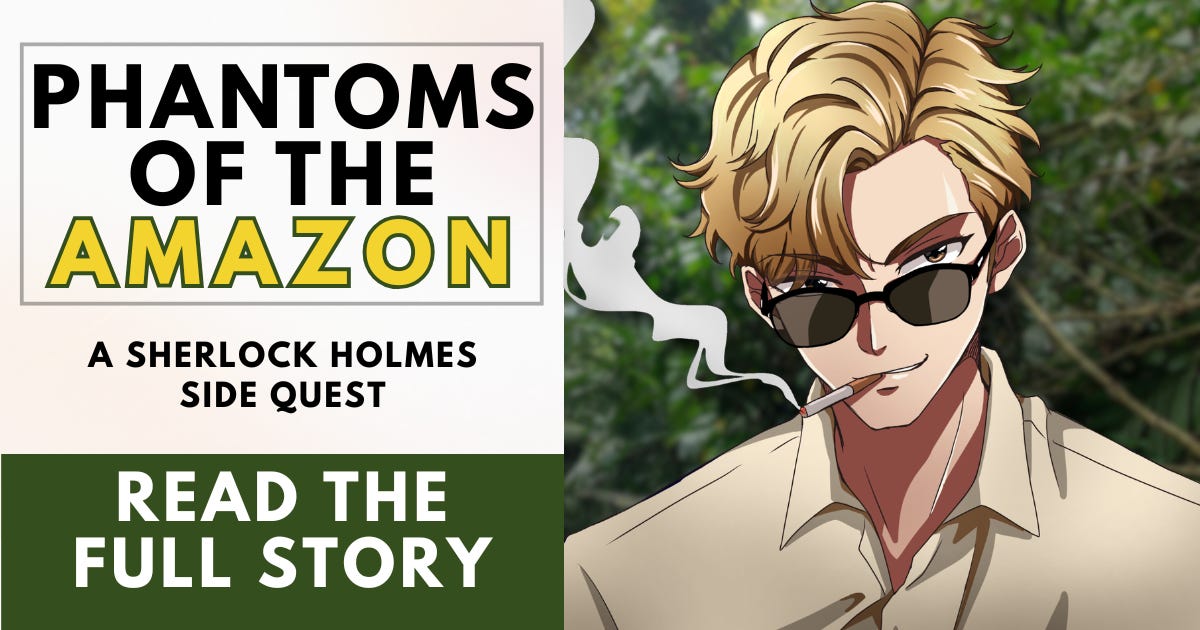
PHANTOMS OF THE AMAZON: A Sherlock Holmes Side Quest
Sherlock Holmes searches for a lost treasure deep inside the Amazon rainforest, and stumbles onto a danger that locals believe is supernatural


Welcome to Phantoms of the Amazon: A Sherlock Holmes Side Quest.
Side Quests are monthly short stories that expand the world of the Sherlock Holmes: Thailand novels.
What’s the story?
Phantoms of the Amazon takes place BEFORE the events of the Sherlock Holmes: Thailand novels, following Sherlock Holmes on his mysterious ten-year journey around the world.
In this story, Holmes searches for a lost treasure deep inside the Amazon rainforest, and stumbles onto a danger that locals believe is supernatural.
Best Ways To Read:
Website | Substack App | Download the eBook version
PHANTOMS OF THE AMAZON:
Following the tattered map, Sherlock Holmes trekked through the Amazon. He was getting closer. He could feel it.
Despite it being midday, it was dark this deep into the rainforest. The sky was hidden by a wall of green foliage, with streaks of sunlight filtering ever so often through the thick tree branches. There was a constant hum of wildlife: buzzing insects, swinging monkeys, screeching macaws. The air was suffocating.
Holmes didn’t care about the conditions. H was having the time of his life. Searching the Amazon for a lost idol from the Inca Empire was not what he expected to be doing when he first arrived in Ecuador. Holmes spent his first day in the capital, Quito. The city was located high in the Andes mountains, at an elevation of over nine thousand feet. It was built by the Spanish in the sixteenth century over the ruins of an ancient Inca city.
Holmes traveled to Ecuador for the same reason he traveled to every country ever since leaving London at age nineteen. Something had captured his interest. His life was a constant search for problems to solve, as the regular routine of existence made him bored to the point of feeling physically ill. He called it “the reaction.” Whenever he solved a problem, a terrible feeling would come over him. It would only go away if he found something else to occupy him, some new problem to solve.
The problem that brought him to Ecuador involved a crime that had baffled the local police. A rare painting had been stolen from the National Museum. Holmes traveled to the capital and offered his services to the department. As he often found, police incompetence was the reason the painting could not be recovered, not some mastermind criminal. Holmes solved the case within the afternoon. Feeling “the reaction” coming upon him, he eagerly looked for something to do next.
He wandered through the city’s historic district, and through a series of random circumstances, ended up in a game of poker in the basement of a dingy bar.
Holmes knew he was desperate for something to do if he was playing cards. At this point, his powers of observation and deduction were developed to such an extent that he could easily tell when someone was lying or cheating, had a good or bad hand. It was too easy. And he knew it wouldn’t occupy his attention for long. Holmes played well as usual, and was up considerably when something finally did manage to truly pique his interest.
One of the players at the table, a grizzled man with a patchy beard, flat nose, and glass eye, was the last in a pot with Holmes. He had no more money to toss in, so he offered something else instead.
“Now this is something very special, señor,” Glass Eye said. He threw in a tattered piece of parchment.
Holmes studied it with interest. “What is it?”
Glass Eye smiled, one of his gold teeth sparkling. “Have you ever heard of the Idol of Limoncocha? A relic of the Inca Empire. It was lost when the Spanish conquered. This is the map to find it.”
The others at the table gasped. One began arguing with Glass Eye in Spanish, as if he was warning him. Glass Eye waved a hand, and showed his cards with a sly grin. The argument stopped.
Holmes picked up the map. The paper was thin and flaky, with reddish-brown spots in numerous places. Someone had drawn on it at some point, but the ink was faded. A line traced through a series of symbols: a tree with two branches raised like arms, a mound of what looked like piled rocks, a waterfall with three streams, a cave with an entrance in the shape of a toucan’s beak, and lastly, what looked like a man’s face with an X over each eye.
“Very valuable, señor, very valuable,” Glass Eye continued. “When the Spanish came, the Inca people hid the idol in a cave deep in the Amazon. Somewhere near Limoncocha. If you travel there and find it, you will be a very rich man.”
Holmes held the map close to his face. While developing his powers of deduction, he had performed extensive research into different kinds of paper and ink, and knew how they aged over time. The map was certainly as old as Glass Eye claimed.
Holmes nodded and placed the map back into the pot.
When they revealed their cards, Holmes knew it was time to leave. Glass Eye slammed the table with his fist, sending coins flying off the table. The others around the table began speaking rapid Spanish. One of the men reached into his pocket.
“Gracias, gentleman,” Holmes said, standing up. “I thank you for the game.” He reached into the pot and only took back the money he had thrown in. “The game itself is enough for me. You can keep your money. But I will be keeping this.” He grabbed the map and left the bar.
The next morning, Holmes set out for Limoncocha, the village in the Amazon where the trail to the idol was supposed to begin. Upon arrival, he booked a room at a rundown guesthouse and spent the next day preparing for his journey. He packed his canvas backpack with enough food and water to last a few days. Then he hired a guide. Once done, he spent the day wandering the village, asking locals if they had heard about the idol.
They all told him the same thing: don’t go looking for it.
When he pressed further, the answer was always the same.
“El fantasma.”
Or translated to English, the phantom.
There were local legends about the idol. It was said that the idol was deep in the rainforest, at the cave of the toucan. A cave that no one had been able to find. Many in the village had looked, and all came back with the same story. The area was guarded by a dark spirit, a phantom. All those who had encountered el fantasma had all described it the same way: the phantom was red and floated through the trees.
Holmes ignored the ghost stories and set out with his guide the following morning. Leaving Limoncocha, they followed the map and Holmes was reassured when they came across the tree with two branches raised like arms, corresponding to the first symbol on the map. They continued on, finding the mound of rocks, and the waterfall with three streams. Everything seemed to be going well, until Holmes heard a blood-curdling scream.
His guide was panting, eyes wide, and pointing in the distance. “El fantasma!” he yelled.
“El fantasma!” Then, without even a glance at Holmes, he sprinted back through the rainforest.
Holmes searched all around him, but didn’t see anything. All he saw was green foliage: thick trees and hanging vines. With only two symbols left on the map, the cave in the shape of a toucan’s beak and the man with X’s for eyes, he pressed onward.
That was hours ago. Holmes was still looking for the cave of the toucan. He wiped sweat from his forehead. Ahead, he saw a clearing and moved toward it, stepping into the sunlight. It was nice to be out of the muggy thickets. He opened his backpack and took a sip from his canteen.
That’s when he saw it.
Far in the distance, through the trees, a red figure was moving.
Holmes stared ahead, then heard a horrible cry, a deep, all-encompassing rumble. He turned and saw a howler monkey on a tree branch, jet-black with a pink mouth. When he looked back, the red figure was gone. He searched all around him. Nothing.
He lowered his sunglasses and rubbed his eyes. It must have been in his imagination, he thought. He took another sip from his canteen and secured it in his backpack. As he continued through the Amazon, he couldn’t help but look over his shoulder.
* * *
Holmes finally found the cave of the toucan. He had initially passed it, reaching a seemingly endless network of caves and thinking there would be a single piece of rock that matched the shape on the map. He eventually discovered that it was not a single piece, but the way a cave appeared when standing at a certain angle. The collection of extended rock formations depicted a toucan’s beak. From there he was able to see a passage, hidden in the shadows.
As he climbed into the cave, he removed his sunglasses and grabbed his flashlight from his backpack. The passage was narrow, but high enough that he could move without having to crouch. The air became colder as he pushed on. Spider webs covered the path. No one had been this way in a very long time.
His footsteps sounded particularly loud in the dead silence of the cave. He shined his flashlight at the walls. There were symbols along the passage, drawn on the rock. They appeared to be people, drawn like crude stick figures. The drawings were spaced out, but began to appear higher, and higher, and—
He stopped.
Moving the light away from the wall and towards the ground, he saw that his boots were at the edge of a chasm. One more step and he would have tumbled down into inky blackness. He brought the light up a bit. The gap from where he stood to the other side of the chasm was too far to jump. But that didn’t matter. When he shined the light directly ahead, he saw that the passage continued only a bit farther before reaching a wall of rock.
It was a dead end.
Had he taken a wrong turn? He looked at the map. He had reached all of the symbols, except one. The last symbol was the man’s face with X’s for eyes. A dead man.
That’s what he would have been if he had taken another step, falling straight into the chasm.
An idea popped into his mind. Maybe that was it?
He pointed his flashlight down the chasm, but he couldn’t see the bottom. He grabbed a nearby rock and tossed it down. He heard it hit the ground.
It was close enough. Reaching into his pocket, he removed his surujin.
Traditionally, a surujin was a Japanese weapon from the martial art of Okinawan kobudo. It consisted of a long rope with two weights attached to each end. A person trained in its use was deadly. The user would spin either end of the surujin in long arcs around their body, with the weight moving at an incredibly fast speed. Those in range of the long rope were in danger; contact with either weight was devastating.
Holmes had designed his surujin himself, adhering to a certain specification. He had to be able to travel with it at all times. Most countries didn’t let you enter with weapons. And with his particular lifestyle, he needed to be prepared for anything.
His surujin was made of three pieces. When the pieces were separate, they looked innocent. Put together, they were dangerous. For the rope, he used a long piece of paracord, a type of lightweight, incredibly strong nylon originally used by American paratroopers in the second World War. For the weights, a rock climbing carabiner was tied to one end of the paracord, and a metal hex-nut, a heavy six-sided steel piece used to secure a bolt, to the other. When swung, the surujin had a range of about fifteen feet. But the paracord was tied in such a way that it could be unraveled if needed, to become considerably longer.
Holmes’ surujin was primarily used as a weapon. He had gotten remarkably good at whirling it around his body. One quick hit from either end, with the carabiner or the hex-nut, would knock out a person’s front teeth, as he had previously been forced to demonstrate during a misunderstanding in Burkina Faso.
In this moment, however, the surujin wasn’t needed as a weapon. He stepped back from the edge of the chasm and began to manipulate the knots along the paracord, unraveling it to its full length. He secured the end with the carabiner to a rock jutting up from the ground. He tossed the other end, the one with the hex-nut, into the chasm. Pocketing his flashlight, he grabbed the paracord with both hands and stepped backward from the ledge, descending into the chasm.
He was wrapped in pure darkness. The tight paracord strained against the flesh of his hands. He couldn’t tell how far he was from the bottom, but continued to step backward against the wall of rock. Finally, one of his boots hit the ground. Testing with the other, he felt the firm floor of the cave and released the paracord.
Removing his flashlight again, he searched all around him. There was another narrow passage nearby. Between its tight walls, something glittered. He squeezed through the gap and was in a small space with drawings on the walls. In the center, on a waist-high platform, was a golden statue.
* * *
Returning to the top of the chasm, Holmes removed the surujin from where it was secured to the rock and re-knotted it to its fifteen-foot range. Once finished, he secured it to his belt and made his way out of the cave. Emerging into the open air, he held a hand over his eyes. The world around him seemed so bright. He removed the idol from his backpack and examined it in the sunlight.
The idol was solid gold and depicted some kind of four-legged creature. Its mouth was open and the tongue curled downward. The ears were pierced with long, rectangular pieces that reached its upper arms.
Holmes felt a sense of accomplishment as he held the idol. Finding it had been quite the task. He had been one step away from falling to his death. As he stood, he felt a terrible sensation pass over his body. A chill spread from head to toe, then an achy pain in his joints. He knew it was “the reaction.” Now that he had found the idol, what was next? The adventure was over, and he dreaded returning to the dull routine of existence.
The sun glared across the face of the golden idol. Holmes reached for his sunglasses, but before he could grab them, he saw it.
Ahead in the trees. A red figure was moving. It seemed to float towards him.
It was el fantasma, the phantom.
As it neared, Holmes’ eyes adjusted to the harsh sunlight, and he noticed something.
The phantom had a face. It had a mouth. It was speaking to him, and pointing a revolver directly at his chest.